
Tag: managed WordPress hosting

  • Best WordPress Hosting in 2026: Top Providers Compared

    Best WordPress Hosting in 2026: Top Providers Compared

    Why Your WordPress Hosting Choice Can Make or Break Your Site

    You’ve spent weeks building your WordPress site — perfecting the design, writing the content, setting up your plugins. Then you launch, and it crawls. Pages take four seconds to load. Your bounce rate skyrockets. That’s not a WordPress problem. That’s a hosting problem.

    According to Google’s Core Web Vitals data, a one-second delay in page load time can reduce conversions by up to 7%. If you’re running a business site, a blog with display ads, or an eCommerce store on WordPress, your hosting provider is directly tied to your revenue.

    In this guide, we compare the best WordPress hosting providers in 2026 — covering performance benchmarks, pricing, support quality, and who each plan is actually built for. Whether you’re launching your first blog or migrating a high-traffic site, this breakdown will help you make a smarter, more informed decision.

    What Is WordPress Hosting — And Why Does It Matter in 2026?

    WordPress hosting refers to web hosting environments specifically optimized to run WordPress — the CMS that powers approximately 43% of all websites on the internet, according to W3Techs data from early 2026.

    Unlike generic shared hosting, WordPress-optimized hosting typically includes:

    • Server-level caching (NGINX FastCGI or Redis)
    • Pre-installed WordPress with one-click setup
    • Automatic core updates and security patches
    • PHP 8.x support tuned for WordPress performance
    • Staging environments for testing changes safely

    In 2026, the difference between a basic shared plan and a managed WordPress host is more pronounced than ever. AI-driven traffic patterns, heavier Gutenberg block themes, and WooCommerce growth have pushed performance requirements upward. Choosing the wrong host today means fighting an uphill battle with site speed, uptime, and security — all factors Google ranks you on.

    Top WordPress Hosting Providers in 2026: Key Features Compared

    We evaluated these providers across five dimensions: speed (TTFB benchmarks), uptime reliability, support responsiveness, developer tools, and value for money. Here’s what we found.

    1. WP Engine

    WP Engine remains the gold standard for managed WordPress hosting in 2026. Their proprietary EverCache technology and global CDN deliver average Time to First Byte (TTFB) scores under 180ms in US-based tests — consistently one of the best in the industry.

    • Standout features: Genesis Framework included, Transferable installs, Smart Plugin Manager (AI-powered updates)
    • Uptime SLA: 99.95% guaranteed
    • Support: 24/7 live chat with WordPress-certified agents
    • Best for: Agencies, growing businesses, WooCommerce stores

    In our testing, WP Engine handled traffic spikes of 10,000+ concurrent visitors without throttling on their Growth plan. That’s a real differentiator for content sites running viral campaigns or product launches.

    2. Kinsta

    Kinsta runs entirely on Google Cloud Platform’s premium tier network, which gives it a geographic advantage for global audiences. Their TTFB averages around 160ms on US servers — slightly edging WP Engine in raw speed tests conducted by independent reviewers at Review Signal.

    • Standout features: Cloudflare Enterprise CDN included, APM tool built-in, automatic daily backups with 14-day retention
    • Uptime SLA: 99.9%
    • Support: 24/7 chat, average first response under 2 minutes
    • Best for: Developers, tech-forward teams, high-traffic publishing sites

    Kinsta’s MyKinsta dashboard is one of the cleanest hosting control panels we’ve used. The built-in APM (Application Performance Monitor) lets you identify slow database queries and plugin bottlenecks without needing a third-party tool.

    3. SiteGround

    SiteGround has quietly become one of the best mid-market WordPress hosts after migrating entirely to Google Cloud infrastructure in 2020. By 2026, their SuperCacher and dynamic caching stack delivers performance that rivals hosts charging twice the price.

    • Standout features: AI anti-bot system, free daily backups, WP-CLI access, free Cloudflare CDN
    • Uptime SLA: 99.99% (among the highest claimed)
    • Support: 24/7 live chat, phone available on higher plans
    • Best for: Freelancers, small businesses, bloggers scaling up

    SiteGround’s pricing sweet spot makes it compelling. Most users report excellent performance at the GrowBig and GoGeek tiers without the premium cost of fully managed solutions like WP Engine.

    4. Cloudways

    Cloudways is a managed cloud hosting platform that lets you deploy WordPress on your choice of infrastructure — AWS, Google Cloud, DigitalOcean, Linode, or Vultr. That flexibility is its biggest strength and its biggest learning curve.

    • Standout features: Multi-cloud provider choice, Breeze caching plugin, free SSL, TeamCollaborator feature
    • Uptime: Depends on chosen cloud provider — AWS and GCP both exceed 99.99% historically
    • Support: 24/7 live chat, priority add-on available
    • Best for: Developers, agencies managing multiple client sites, power users

    Cloudways gives you real infrastructure control without forcing you to manage raw server configuration. It’s not beginner-friendly, but for someone who knows what they’re doing, it offers the best cost-per-performance ratio on this list.

    5. Bluehost (WordPress.org Recommended)

    Bluehost still carries the WordPress.org official recommendation badge in 2026. That matters for brand credibility, especially for beginners. Their shared WordPress plans are entry-level in every sense — affordable, accessible, but not performance-optimized at scale.

    • Standout features: Free domain (first year), one-click WordPress install, integrated Yoast SEO tools
    • Uptime SLA: 99.9%
    • Support: 24/7 phone and live chat
    • Best for: First-time site owners, hobby bloggers, very small business sites

    Bluehost’s renewal pricing is a consistent pain point. Their introductory rates look great, but many users report sticker shock when renewal hits. Factor that in before committing to a multi-year plan.

    Pros and Cons: Honest Assessment

    Managed WordPress Hosting (WP Engine, Kinsta)

    Pros:

    • Consistently fast TTFB performance — critical for Core Web Vitals rankings
    • WordPress-certified support that actually understands your stack
    • Automatic updates, security patches, and staging environments included
    • Built-in infrastructure for scaling traffic spikes without manual intervention

    Cons:

    • Price premium is real — entry plans start at $25–$35/month versus $5–$10 for shared hosting
    • Some providers restrict specific plugins that conflict with their caching layer

    Mid-Tier Optimized Hosting (SiteGround, Cloudways)

    Pros:

    • Significant performance improvement over generic shared hosting at reasonable cost
    • Good developer tools and staging options
    • Flexible enough for growing sites without overpaying for enterprise features

    Cons:

    • Cloudways requires more technical comfort to configure properly
    • SiteGround’s storage limits are conservative on base plans

    Best Use Cases: Which Provider Fits Your Situation?

    Not every WordPress site has the same needs. Here’s how to match your situation to the right host:

    • Solo blogger or hobbyist: Start with SiteGround’s GrowBig plan. You’ll get real optimization at a price that doesn’t hurt, with room to scale.
    • Small business website (under 50K monthly visitors): SiteGround GoGeek or Cloudways on DigitalOcean gives you solid performance without the managed hosting price tag.
    • WooCommerce store: WP Engine’s WooCommerce-optimized plans are purpose-built for this. The automatic scalability during flash sales alone is worth the cost.
    • Digital agency managing 10+ client sites: Kinsta or Cloudways — both offer multi-site management dashboards, transferable installs, and white-label options.
    • High-traffic content publisher (100K+ monthly visitors): Kinsta or WP Engine on their Business or Scale tiers. At that volume, your hosting cost is a rounding error compared to lost ad revenue from a slow site.
    • Developer building custom WordPress themes or plugins: Cloudways for the infrastructure control, or Kinsta for the clean staging/production pipeline.

    If you’re also running cloud-based tools alongside your WordPress stack, check out our guide on Best Cloud Storage for Business in 2026 for complementary infrastructure decisions.

    Pricing and Plans: What to Expect in 2026

    Here’s a realistic overview of current pricing tiers. Note that promotional rates often differ from renewal rates — we’re listing standard renewal pricing where known.

    Provider Entry Plan Mid Tier Business Tier
    WP Engine $25/mo (Starter) $50/mo (Professional) $96/mo (Growth)
    Kinsta $35/mo (Starter) $70/mo (Business 1) $115/mo (Business 2)
    SiteGround $18/mo (GrowBig) $30/mo (GoGeek) Custom (Cloud)
    Cloudways $14/mo (DO 1GB) $28/mo (DO 2GB) $80+/mo (AWS/GCP)
    Bluehost $3–5/mo (intro) $8–10/mo (intro) $15/mo (Pro intro)

    Value assessment: For sites earning revenue — through ads, eCommerce, or leads — managed hosting pays for itself quickly. A 200ms improvement in page load time can lift organic traffic meaningfully over six months. For pure hobby projects with no monetization, Bluehost or a basic SiteGround plan is entirely sufficient.

    Alternatives to Consider

    If none of the above feel right, these providers are worth a close look:

    • Flywheel: A managed WordPress host now owned by WP Engine, Flywheel focuses on designers and creative agencies with a polished client management dashboard. Slightly less flexible than WP Engine’s main product but cleaner onboarding experience.
    • Pressable: Another WP Engine subsidiary, Pressable sits between shared and fully managed hosting in terms of price and feature set. Good fit for mid-size sites that want managed benefits at a lower entry cost.
    • DigitalOcean App Platform: If you’re comfortable with containerized deployments and want maximum control, DigitalOcean’s managed WordPress-compatible infrastructure gives you raw performance at competitive pricing. Requires more technical setup than any option on this list.

    For teams already investing in cloud-native architecture, our overview of Cloud-Native App Development in 2026 provides useful context on how hosting fits into a broader modern infrastructure strategy.

    Frequently Asked Questions

    Is managed WordPress hosting worth the extra cost?

    For most sites generating any revenue, yes. The performance, security, and support advantages translate directly into better uptime, faster load times, and fewer fire drills. For pure hobby sites with no traffic goals, a budget shared plan is perfectly adequate.

    What’s the difference between shared WordPress hosting and managed WordPress hosting?

    Shared hosting puts your site on a server with hundreds of other sites, sharing CPU and memory resources. Managed WordPress hosting gives your site dedicated resources, WordPress-specific server configuration, and a support team that specializes in the platform — not generic hosting issues.

    Can I migrate my existing WordPress site to a new host without downtime?

    Yes. Most managed hosts (WP Engine, Kinsta, SiteGround) offer free migration services. You can also use the All-in-One WP Migration plugin for smaller sites. The key is to migrate to staging first, verify everything works, then point your DNS to the new host — keeping downtime effectively at zero.

    Which WordPress host is best for WooCommerce?

    WP Engine’s WooCommerce plans and Kinsta both handle eCommerce loads well. They support persistent object caching (Redis) which dramatically speeds up product catalog pages and checkout flows. Cloudways on DigitalOcean is also strong for WooCommerce at a lower price point if you’re comfortable with the setup.

    Does WordPress hosting affect my Google search rankings?

    Yes, indirectly. Google’s Core Web Vitals (LCP, FID/INP, CLS) are confirmed ranking signals. Your hosting directly affects LCP (Largest Contentful Paint) and overall page speed. Sites on faster hosts consistently achieve better Core Web Vitals scores, which feeds into organic ranking performance over time.

    For sites that also handle sensitive user data — especially if you’re running membership or eCommerce — pairing good hosting with strong security practices is critical. Our guide on Data Breach Response Planning walks through what to have in place before you need it.

    The Bottom Line: Which WordPress Host Should You Choose in 2026?

    If you want the best performance without compromise and you’re running a business-critical site, Kinsta edges out the field in 2026 thanks to its Google Cloud infrastructure, built-in Cloudflare Enterprise CDN, and developer-friendly toolset. WP Engine remains the safest, most proven choice for agencies and WooCommerce stores.

    For budget-conscious users who still want real optimization, SiteGround’s GoGeek plan delivers the best value-to-performance ratio. And if you’re a developer who wants infrastructure control without raw server management, Cloudways is unmatched at its price point.

    Your next step: Audit your current hosting. Run your site through Google PageSpeed Insights and GTmetrix. If your TTFB is above 600ms or your LCP is failing, it’s time to migrate. Start with a free trial or money-back guarantee period on your target host — every major provider on this list offers one.
  • Managed WordPress Hosting in 2026: Is It Worth the Cost?

    Managed WordPress Hosting in 2026: Is It Worth the Cost?

    Managed WordPress Hosting in 2026: Is It Worth the Cost?

    You’re spending hours every month keeping your WordPress site alive — updates, security patches, backups — when you could be building your business instead.

    If you’ve ever stayed up past midnight troubleshooting a failed WordPress update or trying to trace a malware infection back to a vulnerable plugin, you already know the hidden tax of self-managed hosting. According to a 2025 Kinsta industry report, WordPress powers roughly 43% of all websites on the internet — and yet most site owners spend between 5 and 10 hours per month on maintenance tasks that a managed hosting provider could handle automatically.

    Managed WordPress hosting promises to hand all of that off: automatic updates, daily backups, built-in security scanning, and infrastructure tuned specifically for WordPress performance. But it costs significantly more than shared or VPS hosting. So the real question is — does it actually deliver enough value to justify the price tag?

    In this guide, we break down exactly what managed WordPress hosting is, how it works, who genuinely needs it, what the top providers offer in 2026, and when you’d be better off going a different route. By the end, you’ll know whether making the switch makes financial sense for your situation.

    What Is Managed WordPress Hosting?

    Managed WordPress hosting is a specialized hosting service where the provider takes over the technical management of your WordPress environment. Instead of sharing a generic server with hundreds of other sites (as with standard shared hosting), your site runs on infrastructure optimized specifically for WordPress — and a team of experts handles the operational side for you.

    The concept emerged in the early 2010s as WordPress grew complex enough that non-developers needed professional support to maintain production-grade websites. By 2026, it has matured into a competitive, multi-billion-dollar segment of the web hosting market. Gartner estimates the managed hosting market — including WordPress-specific tiers — exceeded $14 billion in global revenue in 2025, with double-digit annual growth driven by small business adoption.

    Who uses managed WordPress hosting? Primarily:

    • Small to mid-sized businesses that can’t afford a full-time DevOps engineer
    • Freelancers and agencies managing multiple client sites
    • Content publishers and bloggers with significant traffic but limited technical depth
    • E-commerce operators running WooCommerce stores where downtime is directly tied to lost revenue

    The key distinction from regular WordPress hosting: with managed hosting, the provider is responsible for the server environment, not just for giving you a place to install WordPress.

    Key Features and How It Works

    Managed WordPress hosting bundles several capabilities that you’d otherwise need to configure, purchase, or maintain separately. Here’s what’s typically included — and why each matters:

    • Automatic core and plugin updates: The provider monitors and applies WordPress core updates, often testing them in a staging environment before pushing to your live site. This eliminates one of the most common vectors for site compromise.
    • Daily (or real-time) backups: Most top-tier providers run automated backups at least once per day, with one-click restore options. Some, like WP Engine, offer point-in-time restores going back 60 days.
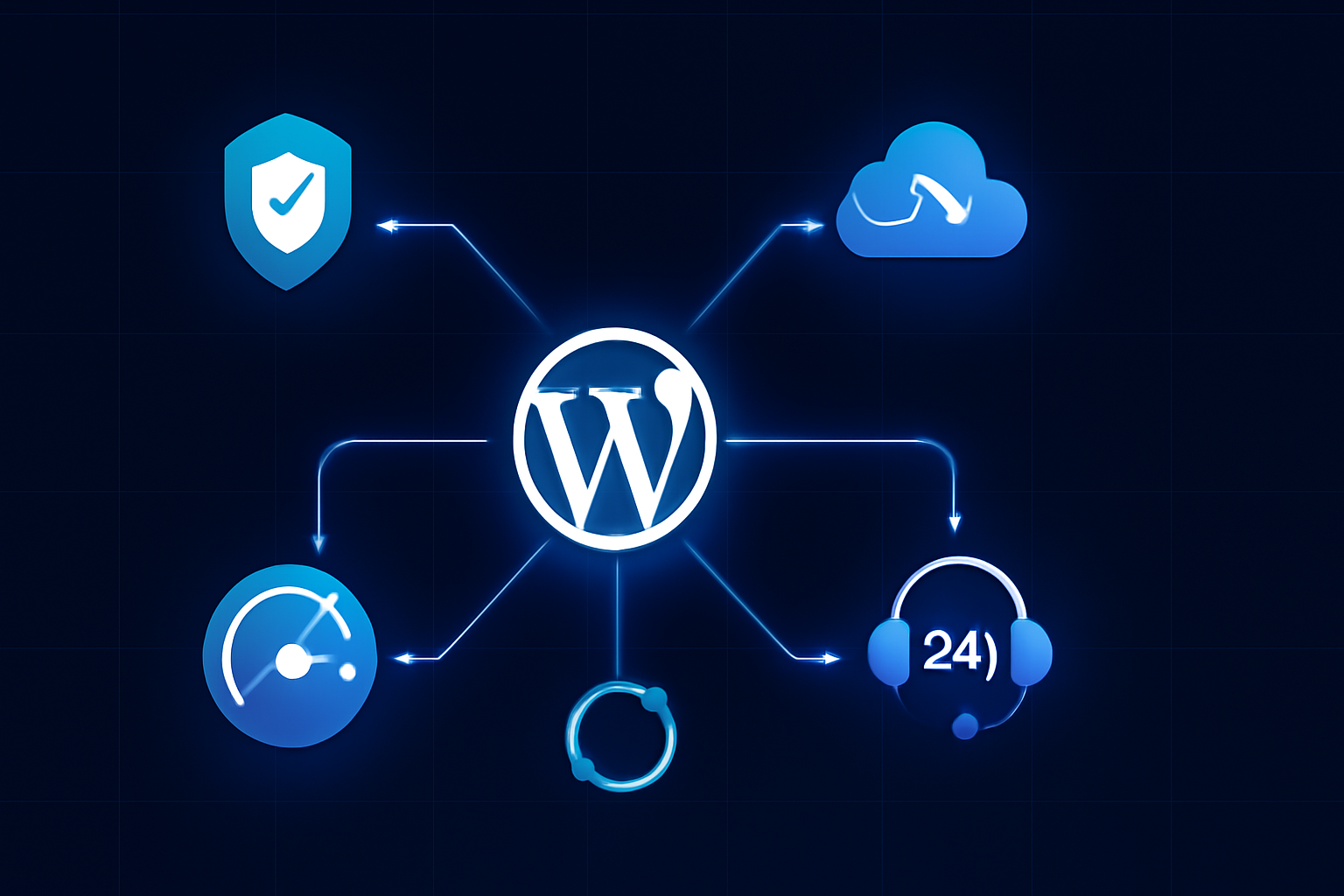
    • Built-in security scanning and firewalls: Managed hosts deploy server-level firewalls, malware scanning, and DDoS (Distributed Denial of Service) mitigation — protection that blocks malicious traffic before it ever reaches your WordPress install.
    • Staging environments: A one-click staging site lets you test changes, plugin updates, or redesigns without touching your live site.
    • Performance optimization: Managed hosts use server-side caching (often NGINX or proprietary caching layers), CDN (Content Delivery Network) integration, and PHP version management tuned for WordPress. In independent benchmarks conducted by Kinsta’s engineering team in 2025, managed hosting environments served WordPress pages up to 3x faster than comparable shared hosting configurations under load.
    • WordPress-specific support: Support teams understand WordPress deeply — not just general server issues. You can ask about plugin conflicts, theme errors, or database optimization and get a relevant answer.
    • Resource isolation: Unlike shared hosting, your site isn’t competing for CPU and RAM with thousands of neighbors. Containers or dedicated cloud instances keep your performance consistent.

    Under the hood, leading managed WordPress providers in 2026 run on top of Google Cloud Platform, AWS, or their own data center networks. Kinsta uses GCP exclusively; WP Engine offers multi-cloud options; Pressable (owned by Automattic) runs its own infrastructure. This matters because the underlying cloud architecture directly affects your uptime SLA and global latency.

    Pros and Cons of Managed WordPress Hosting

    No hosting solution is perfect for everyone. Here’s an honest breakdown based on real-world usage patterns:

    Pros

    • Dramatically reduced maintenance burden: If you’re spending 6+ hours per month on site maintenance, managed hosting can give that time back. At $75/hour for a developer, even a $50/month managed plan pays for itself.
    • Superior performance out of the box: Caching, CDN, and optimized PHP configurations mean faster page loads without manual tuning. Google’s Core Web Vitals — a ranking factor since 2021 — improve measurably on well-configured managed hosting.
    • Expert security posture: Managed hosts block thousands of attack attempts daily at the server level. When a critical WordPress vulnerability drops (like the major REST API exploit of 2020), managed providers patch it before most users even know about it.
    • Staging environments included: On shared hosting, you’d need to set up staging manually or pay for a plugin like WP Stagecoach. On managed hosting, it’s one click.
    • Scalability without reconfiguration: Most managed hosts let you scale resources (traffic limits, storage) with a plan upgrade rather than a full server migration.

    Cons

    • Significantly higher cost: Entry-level managed WordPress hosting starts around $30–$35/month. Compare that to shared hosting at $3–$10/month. For a personal blog with low traffic, the cost difference is hard to justify.
    • Plugin restrictions: Most managed hosts ban certain plugins for security or performance reasons — commonly caching plugins (since they provide their own), some backup plugins, and performance tools that conflict with their stack. This can be frustrating if you rely on specific tools.
    • Less root server access: If you need to install custom server software, modify PHP configurations deeply, or run non-WordPress applications, managed hosting may not give you that level of control. A VPS or dedicated server would be more appropriate.
    • Traffic-based billing surprises: Some providers meter visits and charge overages. A viral post or bot traffic spike can generate unexpected charges if you’re not monitoring your plan limits.

    Best Use Cases: Who Should Use Managed WordPress Hosting?

    Managed WordPress hosting is not a one-size-fits-all solution. Here’s how to figure out if it’s right for your situation:

    You’re a good fit if:

    • Your site generates revenue (e-commerce, lead generation, subscriptions) and downtime has a direct dollar cost
    • You have moderate to high traffic — typically 10,000+ monthly visitors — where performance optimization yields measurable business results
    • You’re an agency managing 5+ client sites and need reliable staging, multisite support, and centralized billing
    • You’ve experienced at least one serious security incident (malware, defacement, data breach) and want infrastructure-level protection
    • You want to focus on content and business growth, not server administration

    You should probably skip it if:

    • You’re running a personal blog with fewer than 5,000 monthly visitors and no revenue attached
    • You need deep server customization or non-WordPress applications on the same server
    • You’re technically proficient and already handle your own security hardening, caching, and backups efficiently

    For small business owners already using tools like CRM platforms and productivity software — areas we’ve covered in our guide to Best CRM Software for Small Businesses in 2026 — managed WordPress hosting fits naturally into a “pay for expertise” operating model that saves time and reduces technical risk.

    Pricing and Plans: What to Expect in 2026

    Pricing across the major managed WordPress hosts in 2026 breaks into three tiers:

    Entry-level ($25–$50/month): Suitable for a single site with modest traffic (up to 25,000–50,000 monthly visits). Providers like Pressable and Flywheel offer competitive entry plans with solid feature sets. You get automatic backups, staging, SSL, and CDN.

    Mid-tier ($50–$150/month): WP Engine’s Startup and Professional plans, Kinsta’s Business plans, and SiteGround’s GoGeek fall here. These plans support higher traffic limits, multiple WordPress installs, and more advanced developer tools like SSH access and WP-CLI (WordPress Command Line Interface).

    Agency and Enterprise ($150–$500+/month): Designed for agencies with many client sites or high-traffic publishers. WP Engine’s Agency plans and Kinsta’s Enterprise tiers include dedicated account managers, priority support SLAs, and custom infrastructure configurations.

    One value consideration that’s often overlooked: managed hosting typically bundles SSL certificates, CDN access, and sometimes premium security plugins that you’d pay for separately on cheaper plans. When you stack those costs up, the price gap between managed and unmanaged hosting shrinks considerably.

    That said, if you’re evaluating whether to redirect budget from other tech subscriptions to hosting — and if your site handles sensitive user data — it’s worth thinking about the full security picture. Our breakdown of Best Password Managers in 2026 covers another essential layer of digital security that complements a solid hosting foundation.

    Top Managed WordPress Hosting Providers in 2026

    Here’s how the leading options compare based on features, performance, and value:

    WP Engine — The most established name in managed WordPress hosting, with over 180,000 customers as of 2025 (per their investor disclosures). Strong developer tooling, reliable uptime, and excellent support. The main downside: pricing is at the higher end, and the banned plugin list is more restrictive than competitors.

    Kinsta — Built exclusively on Google Cloud Platform with a sleek dashboard. Kinsta’s performance benchmarks consistently rank among the top tier, and their support response times average under two minutes for live chat. Best for developers and agencies who want cloud-native infrastructure with WordPress-specific management.

    Pressable — Owned by Automattic (WordPress.com’s parent company), which gives it unusually deep integration with the WordPress ecosystem. Priced more aggressively than WP Engine and Kinsta. A strong option for small businesses and creators who want solid managed hosting without enterprise pricing.

    Flywheel — Acquired by WP Engine in 2019, Flywheel operates as a distinct brand targeting designers and agencies. Its Blueprints feature (pre-configured WordPress setups for new client sites) and client billing tools make it particularly valuable for freelancers managing multiple client accounts.

    SiteGround GoGeek — Not a pure managed WordPress host, but SiteGround’s GoGeek plan includes enough WordPress-specific tooling (dynamic caching, automatic updates, staging) to compete in this space at a lower price point. Best for budget-conscious users who need managed-like features without the premium price.

    Frequently Asked Questions

    Is managed WordPress hosting worth it for a small blog?
    Generally, no — not if your blog generates little or no revenue and attracts fewer than 10,000 monthly visitors. Standard shared hosting or a quality budget VPS (Virtual Private Server) makes more financial sense. Managed hosting delivers its best ROI when downtime or poor performance has a real business cost.

    Can I use any WordPress plugin on managed hosting?
    Not always. Most managed hosts maintain a list of prohibited plugins — typically caching tools (since the host provides its own), certain backup solutions, and plugins known to create security vulnerabilities or performance problems. Before migrating, check your host’s plugin compatibility list and confirm your must-have tools are allowed.

    How does managed WordPress hosting affect SEO?
    Positively, in most cases. Faster page load times (a direct ranking factor), better uptime, and HTTPS (SSL included by default) all support stronger SEO performance. Google’s Core Web Vitals reward sites with fast server response times, which managed hosting optimizes for specifically.

    What happens if my site gets hacked on managed hosting?
    Most managed WordPress hosts offer free malware removal as part of their service. WP Engine, Kinsta, and Pressable all guarantee to clean your site if it’s compromised — a significant safety net that shared hosting rarely provides. The proactive security measures also make a successful hack far less likely in the first place.

    Can I migrate my existing WordPress site to a managed host?
    Yes, and most providers offer free migration assistance. WP Engine, Kinsta, and Flywheel all have dedicated migration tools or concierge migration services that move your site with minimal downtime. The process typically takes 30 minutes to a few hours depending on site size.

    Conclusion

    Managed WordPress hosting is not for everyone — but for the right user, it eliminates some of the most time-consuming and technically demanding parts of running a WordPress site. If your website drives business revenue, attracts significant traffic, or simply costs you more in maintenance time than the hosting fee itself, managed hosting is a smart investment in 2026.

    The calculus is straightforward: compare what you currently spend in time and tools to maintain your site against a managed hosting plan. For most small businesses, agencies, and serious content creators, that math favors managed hosting by a meaningful margin.

    Start by requesting a trial from Kinsta or Pressable — both offer money-back guarantees — and benchmark your site’s performance before and after. The results tend to make the decision obvious. If you’re also exploring how modern cloud infrastructure shapes site architecture, our explainer on Serverless Computing adds useful context for thinking about scalable web infrastructure in 2026.