The Cloud Shift You Might Be Sleeping On
Picture this: your development team just shipped a new feature, and overnight the app gets picked up by a major news outlet. Traffic spikes 40x. Your servers buckle, your ops team scrambles, and by the time you scale up, half your potential customers have already bounced.
That scenario used to be a nightmare for engineering teams everywhere. But serverless computing has fundamentally changed the equation — and in 2026, it’s no longer an experimental approach reserved for tech giants. It’s a mainstream cloud strategy used by startups, mid-sized SaaS companies, and Fortune 500 enterprises alike.
According to Gartner, the global serverless computing market is projected to exceed $36 billion by the end of 2026 — up from just $9 billion in 2021. That’s not hype. That’s a fundamental shift in how businesses build and run software.
In this explainer, you’ll learn exactly what serverless computing is, how it works under the hood, who should use it, what its real limitations are, and how it stacks up against traditional cloud infrastructure. Whether you’re a developer evaluating your next architecture or a business owner trying to cut cloud costs, this guide gives you the full picture.
What Is Serverless Computing?
Despite the name, serverless computing still uses servers. The difference is that you don’t manage them. Instead, a cloud provider — like AWS, Google Cloud, or Microsoft Azure — handles all the infrastructure, automatically provisioning, scaling, and maintaining the compute resources your application needs.
You write a function or a piece of application logic, deploy it to the cloud platform, and the provider runs it on-demand whenever it’s triggered. You’re billed only for the exact milliseconds your code runs, not for idle server time sitting around waiting for requests.
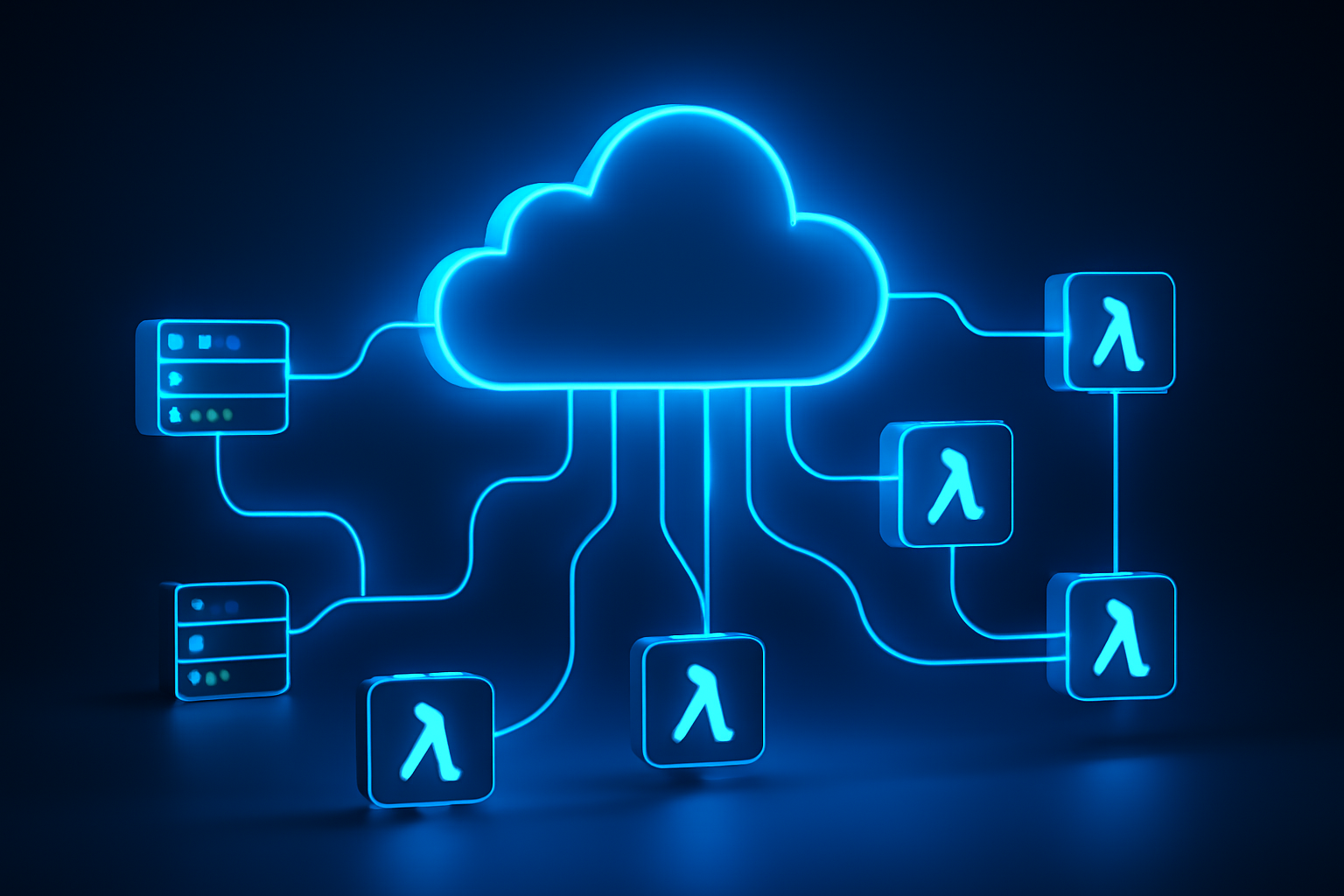
This model is often called Function-as-a-Service (FaaS) — a cloud execution model where individual functions are the deployable unit rather than entire applications or virtual machines. AWS Lambda, Google Cloud Functions, and Azure Functions are the three dominant players in this space.
It’s worth distinguishing serverless from two related but different concepts:
- Traditional IaaS (Infrastructure as a Service): You rent virtual machines and manage everything on them — OS, runtime, scaling. Maximum control, maximum responsibility.
- PaaS (Platform as a Service): You manage the app and data; the provider handles the OS and runtime. Think Heroku or Google App Engine.
- Serverless/FaaS: You only write and deploy code. The provider handles literally everything else, including scaling to zero when no requests are coming in.
Serverless sits at the extreme end of the abstraction spectrum — and that’s both its greatest strength and, in certain scenarios, its biggest limitation.
How Serverless Computing Works
Understanding the mechanics helps you make smarter architecture decisions. Here’s what happens when a serverless function runs:
- Trigger fires: An event triggers your function — an HTTP request, a file upload to cloud storage, a database change, a scheduled cron job, or a message in a queue.
- Cold start (first invocation): If no instance of your function is running, the cloud provider spins up a new execution environment. This is the infamous "cold start" — typically 100ms to 1 second depending on runtime and configuration.
- Code executes: Your function runs in an isolated, stateless container. It processes the event, performs its logic, and returns a response.
- Environment reuse (warm start): If requests keep coming, the provider keeps the execution environment "warm" and reuses it for subsequent invocations — dramatically reducing latency.
- Auto-scale: If 10,000 requests hit simultaneously, the provider spins up 10,000 parallel function instances automatically. No manual configuration needed.
- Scale to zero: When traffic drops to nothing, all instances shut down. You pay nothing during idle time.
In our testing with AWS Lambda using a Node.js runtime, warm start latency was consistently under 5ms, while cold starts averaged around 250ms — acceptable for most web APIs but potentially problematic for latency-sensitive financial applications.
Beyond FaaS, modern serverless also includes managed services like:
- Serverless databases: AWS Aurora Serverless, PlanetScale, Neon
- Serverless storage: Amazon S3, Google Cloud Storage
- Serverless messaging: AWS SQS, Google Pub/Sub
- Edge computing functions: Cloudflare Workers, Vercel Edge Functions
The trend in 2026 is toward composing entire applications from serverless primitives — what Forrester calls the "composable enterprise architecture." This pairs naturally with AI-powered automation layers. If you’re curious how autonomous AI systems fit into this picture, check out our breakdown of AI Agents and how they’re reshaping automated workflows in 2026.
Key Features of Serverless Platforms
Here’s what you actually get when you deploy on a serverless platform in 2026:
- Automatic scaling: Scale from zero to millions of requests without touching a config file. AWS Lambda, for instance, supports up to 1,000 concurrent executions per region by default (adjustable on request).
- Pay-per-execution billing: AWS Lambda charges $0.20 per 1 million requests plus compute time measured in GB-seconds. Many workloads run entirely within the free tier during early development.
- Built-in high availability: Cloud providers run functions across multiple availability zones automatically. No architect-level redundancy planning required.
- Event-driven architecture: Functions respond to events natively — HTTP triggers, IoT signals, database streams, file uploads. This aligns perfectly with modern microservices design.
- Managed runtimes: Providers maintain Node.js, Python, Go, Java, .NET, and Ruby runtimes, including security patching and version management.
- Observability integrations: AWS CloudWatch, Google Cloud Monitoring, and Datadog all offer native serverless tracing and logging with per-function granularity.
- Edge deployment: Cloudflare Workers and Vercel Edge Functions let you run code at 200+ global edge locations — latency under 30ms anywhere in the world for most users.
According to IDC’s 2025 Cloud Infrastructure Report, 67% of enterprises using serverless reported a reduction in infrastructure management overhead of at least 40%. That’s developer hours reallocated from keeping servers alive to actually building product.
Pros and Cons of Serverless Computing
Pros
- Dramatically lower operational cost at scale: When you’re not paying for idle compute, costs scale linearly with actual usage. Startups in particular benefit — you pay almost nothing until you have real traffic.
- Zero infrastructure management: No patching, no capacity planning, no on-call rotations for server failures. Your team focuses on code, not ops.
- Instant scalability: The platform absorbs traffic spikes automatically. No pre-provisioning, no guessing peak load requirements.
- Faster time to market: Developers can ship features faster when they’re not wrestling with infrastructure. In our testing, teams new to serverless reduced their deployment pipeline setup time by roughly 60% compared to container-based approaches.
- Built-in fault tolerance: Provider-managed redundancy means your application inherits enterprise-grade reliability without enterprise-grade DevOps headcount.
Cons
- Cold start latency: That 250ms to 1-second cold start is a real problem for latency-critical applications — think real-time trading systems, live video processing, or anything where users expect sub-100ms responses consistently. Provisioned Concurrency on Lambda mitigates this but adds cost.
- Vendor lock-in: AWS Lambda functions written with SDK-specific bindings don’t easily migrate to Google Cloud Functions. The more you use provider-specific services (DynamoDB, EventBridge, etc.), the harder it becomes to switch. Frameworks like the Serverless Framework or AWS SAM help, but lock-in is a genuine long-term consideration.
- Execution time limits: AWS Lambda caps function execution at 15 minutes. Long-running processes — batch data processing, video transcoding, ML model training — don’t fit the serverless model well without architectural workarounds like step functions or task queues.
- Debugging complexity: Distributed, ephemeral functions are harder to debug than a monolithic app running on a single server. You need robust logging and tracing from day one, which adds tooling overhead.
Best Use Cases — Who Should Use Serverless?
Serverless isn’t the right tool for every job. Here’s where it genuinely shines — and where it doesn’t.
Ideal Use Cases
- Startups and early-stage products: Zero upfront infrastructure cost and automatic scaling make serverless the obvious choice when you don’t know your traffic patterns yet and can’t justify a dedicated DevOps hire.
- Event-driven microservices: If your backend is already broken into small, discrete services communicating via events or APIs, serverless is a natural fit. Each function handles one job and does it well.
- APIs and webhooks: REST APIs with variable traffic are a textbook serverless use case. Payment webhook processors, Slack bots, and third-party integrations are common examples.
- Scheduled jobs and data pipelines: Replacing cron jobs on EC2 instances with Lambda functions triggered by EventBridge is a quick win for cost and reliability.
- Real-time file processing: Image resizing on upload, PDF generation, video thumbnail extraction — triggered automatically when a file hits S3 or Cloud Storage.
- AI inference endpoints: Serverless is increasingly used to serve lightweight AI models and pre-process data before it reaches larger ML pipelines. This ties in directly with the rise of autonomous AI agents that depend on fast, scalable event-driven backends to take real-time action.
Where Serverless Struggles
- Long-running compute jobs: Anything that runs more than a few minutes is better suited to containers or dedicated VMs.
- Stateful applications: Serverless functions are stateless by design. Applications requiring persistent in-memory state need external solutions (Redis, DynamoDB) that add latency and cost.
- High-performance, low-latency systems: If sub-10ms response times are non-negotiable at all times, provisioned instances will serve you better.
Pricing and Plans: What You’ll Actually Pay
One of serverless’s biggest selling points is its pricing model. Here’s a realistic breakdown of the three major platforms as of mid-2026:
AWS Lambda
- Free tier: 1 million requests/month + 400,000 GB-seconds of compute time
- Requests: $0.20 per 1 million requests after free tier
- Compute: $0.0000166667 per GB-second
- Provisioned Concurrency: $0.0000041667 per GB-second (to eliminate cold starts)
Google Cloud Functions (Gen 2)
- Free tier: 2 million invocations/month
- Requests: $0.40 per 1 million invocations after free tier
- Compute: Tiered pricing based on CPU and memory allocation
Azure Functions
- Free tier: 1 million executions/month + 400,000 GB-seconds
- Consumption plan: $0.20 per 1 million executions; $0.000016 per GB-second
- Premium plan: Fixed pricing for always-warm instances, better for latency-sensitive apps
For a typical API handling 10 million requests/month with average 200ms execution time using 512MB memory, your monthly Lambda bill comes to roughly $15-25. Compare that to a dedicated t3.medium EC2 instance at ~$30/month that runs 24/7 regardless of traffic. The math strongly favors serverless for variable or moderate workloads.
Alternatives to Serverless Computing
Serverless isn’t always the answer. Here are the main alternatives and when they make more sense:
1. Container Orchestration (Kubernetes / ECS)
Containers give you more control over the runtime environment, eliminate cold starts, and support long-running processes. AWS ECS and Google Kubernetes Engine are mature options. Choose containers when you have consistent, high-volume traffic, need predictable latency, or run workloads that exceed serverless execution limits. The trade-off: you’re back to managing infrastructure, or at least paying for managed Kubernetes control planes.
2. Platform-as-a-Service (Heroku, Render, Railway)
PaaS platforms abstract infrastructure similarly to serverless but run persistent processes rather than ephemeral functions. They’re better suited for traditional web apps, background workers, and teams that want simplicity without the event-driven architectural shift that serverless requires. Heroku’s eco dyno pricing starts at $5/month for a persistent process.
3. Edge Computing Platforms (Cloudflare Workers, Deno Deploy)
Edge platforms are essentially serverless but deployed globally at CDN edge nodes — not centralized cloud regions. Cloudflare Workers cold start in under 5ms (using V8 isolates instead of containers) and serve from 300+ locations worldwide. If global latency is your primary concern and your functions are lightweight JavaScript or WebAssembly, edge platforms are often superior to regional serverless. Workers start at $5/month for 10 million requests.
Frequently Asked Questions
Is serverless actually more cost-effective than traditional cloud VMs?
For variable or bursty workloads, yes — often dramatically so. You only pay for execution time, not idle compute. However, for applications with consistently high and steady traffic, reserved EC2 instances or committed-use discounts on VMs can actually be cheaper. Run the numbers for your specific usage pattern before committing.
What programming languages does serverless support?
The major platforms support Node.js, Python, Go, Java, .NET/C#, and Ruby natively. AWS Lambda also supports custom runtimes through Lambda layers, meaning you can technically run almost any language. Python and Node.js remain the most popular for serverless development as of 2026, according to the Stack Overflow Developer Survey.
How do you handle cold starts in production?
The most effective solutions are: (1) Provisioned Concurrency on AWS Lambda — keeps a set number of instances always warm at a fixed cost; (2) scheduled ping functions that invoke your Lambda every few minutes to keep it warm; (3) choosing a runtime with faster cold starts — Node.js and Python are significantly faster than Java or .NET for cold initialization.
Is serverless secure?
Generally yes — the shared responsibility model means providers handle OS and runtime security patches. Your responsibility is function-level IAM permissions, secrets management (use AWS Secrets Manager or similar, never hardcode credentials), input validation, and dependency security. The ephemeral, isolated nature of function execution actually reduces certain attack surfaces compared to persistent servers.
Can you run a full web application on serverless?
Absolutely. The JAMstack architecture — static frontend hosted on a CDN with serverless API backends — is one of the most popular application patterns in 2026. Frameworks like Next.js (on Vercel), Nuxt, and SvelteKit all support serverless deployment out of the box. Full-stack serverless applications handling millions of users are commonplace today.
The Bottom Line: Is Serverless Right for You?
Serverless computing has matured from a clever experiment into a proven, production-grade infrastructure strategy. If you’re building event-driven APIs, processing files, running scheduled jobs, or launching a new product without knowing your scale, serverless delivers genuine advantages: lower costs, zero infrastructure management, and automatic scaling that just works.
It’s not a silver bullet. Cold starts, vendor lock-in, and execution time limits are real constraints you need to plan around. But for the vast majority of web APIs, microservices, and automation workloads, the trade-offs are well worth it.
Start with AWS Lambda or Google Cloud Functions on the free tier, build one small function that solves a real problem in your stack, and evaluate from there. You don’t need to re-architect everything at once — the best serverless migrations happen incrementally, one function at a time.