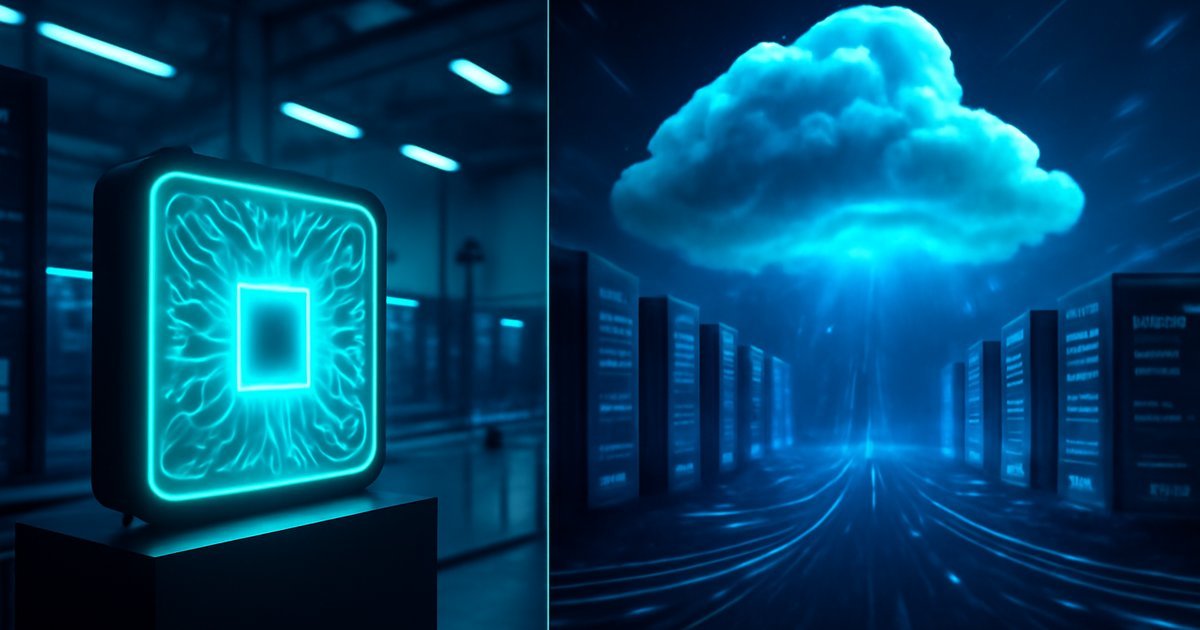
When the Cloud Isn’t Fast Enough
You’ve probably heard that moving everything to the cloud is the smart play in 2026. And for most workloads, it absolutely is. But here’s the problem nobody talks about: the cloud is hundreds — sometimes thousands — of miles away from your users, your sensors, and your data sources.
That distance creates latency. And for a growing set of applications — autonomous vehicles, industrial automation, real-time video analytics, augmented reality — even 50 milliseconds of delay is unacceptable. That’s where edge computing enters the picture.
According to Gartner, by 2025 more than 75% of enterprise-generated data was being processed outside traditional centralized data centers — a dramatic shift from just 10% in 2018. That number has only grown since.
This article breaks down exactly what edge computing is, how it compares to cloud computing, when to use each, and how many organizations are now combining both into a hybrid architecture that gets the best of both worlds.
What Is Edge Computing?
Edge computing is a distributed IT architecture where data processing happens physically close to — or at — the source of data generation. Instead of sending every byte to a centralized cloud data center, edge computing pushes computation to local servers, gateways, routers, or even the devices themselves.
Think of it this way: cloud computing is like a library at the center of a city. Powerful, comprehensive, but you have to travel to get there. Edge computing is like putting a small reading room in every neighborhood — less comprehensive, but immediately accessible.
Common edge computing deployments include:
- Industrial edge nodes — servers placed on factory floors to process sensor data in real time
- Retail edge systems — local servers in stores handling inventory tracking and checkout systems
- Telecom edge (MEC) — Mobile Edge Computing built into 5G base stations
- IoT gateways — small devices aggregating and filtering data from dozens of sensors before sending summaries to the cloud
- CDN edge nodes — content delivery network servers that cache and serve web content close to end users
IDC projected the global edge computing market to reach $232 billion by 2026, growing at a compound annual rate of over 15%. That’s not a niche trend — it’s a fundamental shift in how infrastructure is architected.
What Is Cloud Computing? (A Quick Refresher)
Cloud computing delivers computing resources — servers, storage, databases, networking, software, analytics — over the internet from centralized data centers operated by providers like AWS, Microsoft Azure, and Google Cloud.
The core value propositions haven’t changed:
- Elasticity — scale up or down instantly based on demand
- Pay-as-you-go pricing — no upfront hardware investment
- Global reach — deploy to regions worldwide through a few clicks
- Managed services — let the provider handle infrastructure maintenance, patching, and uptime
- Ecosystem depth — access to AI/ML tools, databases, DevOps pipelines, and thousands of integrations
AWS alone offers over 200 services across compute, storage, AI, security, and more. That breadth is something edge computing simply can’t replicate locally.
As of early 2026, AWS holds approximately 31% of the global cloud infrastructure market, followed by Azure at 25% and Google Cloud at 11%, according to Statista. The cloud isn’t going anywhere — but it is being extended.
Edge vs. Cloud: Key Differences Side by Side
Understanding the practical trade-offs is where most decisions actually get made. Here’s how these two architectures compare across the dimensions that matter most:
| Factor | Edge Computing | Cloud Computing |
|---|---|---|
| Latency | 1–5 ms (local) | 20–100+ ms (regional) |
| Compute Power | Limited (local hardware) | Near-unlimited (on-demand) |
| Upfront Cost | Higher (hardware required) | Low (OpEx model) |
| Connectivity Dependence | Works offline | Requires internet |
| Data Privacy | Stays on-premises | Sent to third-party servers |
| Scalability | Limited by local capacity | Virtually unlimited |
| Management Complexity | Higher (distributed nodes) | Centralized, managed |
| Best For | Real-time, latency-sensitive apps | Analytics, storage, SaaS |
Pros and Cons of Each Architecture
Edge Computing
Pros:
- Ultra-low latency — processing happens in milliseconds locally, enabling real-time decisions
- Works without internet — critical for remote locations, manufacturing floors, and disaster-prone areas
- Better data sovereignty — sensitive data never leaves your facility, helping with HIPAA, GDPR, and other compliance frameworks
- Reduced bandwidth costs — only processed summaries or alerts are sent to the cloud, not raw data streams
Cons:
- Hardware investment upfront — deploying edge nodes at multiple locations isn’t cheap
- Distributed management headache — patching, monitoring, and securing dozens of edge sites multiplies IT workload significantly
- Limited compute ceiling — complex ML model training or large-scale data analytics still require centralized cloud resources
Cloud Computing
Pros:
- Massive scalability — handle traffic spikes without pre-provisioning capacity
- Deep service ecosystem — AI, ML, data warehousing, CI/CD pipelines, all integrated
- Low barrier to entry — spin up infrastructure in minutes with a credit card
- Automatic updates and managed services — less operational overhead for dev teams
Cons:
- Latency is real — even the closest AWS region introduces delays unacceptable for certain use cases
- Costs can spiral — without governance, cloud bills become unpredictable (see our breakdown in Cloud Cost Optimization in 2026: Cut Your AWS & Azure Bills)
- Internet dependency — an outage at your ISP or the cloud provider affects your entire operation
Best Use Cases: When to Choose Edge vs. Cloud
Choose Edge Computing When:
- You need sub-10ms response times — autonomous vehicles processing LIDAR data, robotic surgery systems, real-time fraud detection at POS terminals
- You’re in a connectivity-constrained environment — offshore oil rigs, mining operations, rural agricultural sensors
- Data privacy regulations restrict data movement — healthcare imaging systems, financial transaction records, government applications
- You generate massive raw data volumes — a single smart factory can generate 1 petabyte of sensor data per day; sending all of it to the cloud is cost-prohibitive
Choose Cloud Computing When:
- You need flexible, scalable compute — e-commerce platforms, SaaS applications, content platforms with variable traffic
- You’re running AI/ML workloads — training large models requires GPU clusters that only cloud providers can economically offer
- Your team is small and lean — managed cloud services let you skip the infrastructure team entirely
- You need global distribution — serving users across multiple continents without building your own data centers
The Third Path: Edge-Cloud Hybrid
In practice, most sophisticated deployments in 2026 use both. The pattern is straightforward: edge nodes handle real-time local decisions, then ship summarized, processed data up to the cloud for long-term storage, model retraining, compliance archiving, and business analytics.
AWS Outposts, Azure Arc, and Google Distributed Cloud are all designed specifically for this hybrid model — letting you manage edge and cloud resources from a single control plane. When we look at enterprise architecture patterns across manufacturing and logistics sectors, this edge-to-cloud pipeline has become the dominant design pattern, not an edge case (pun intended).
If you’re already managing cloud infrastructure, pairing it with smart cost optimization practices becomes even more important as your architecture grows in complexity.
Pricing Realities: What Each Model Actually Costs
Cloud Computing Costs
Cloud pricing varies dramatically by workload, but here are real-world reference points as of mid-2026:
- AWS EC2 t3.medium (2 vCPU, 4 GB RAM): ~$0.0416/hour or ~$30/month on-demand
- Azure Blob Storage: ~$0.018 per GB/month for hot tier
- Google Cloud Run: free tier available; $0.00002400 per vCPU-second beyond free tier
- Data egress: this is the silent budget killer — AWS charges $0.09/GB for data transferred out to the internet
Egress fees are exactly why edge computing reduces cloud bills for high-volume IoT deployments. When you filter and aggregate data at the edge, you send 10x–100x less data to the cloud.
Edge Computing Costs
Edge is a CapEx-heavy model upfront:
- Edge servers (e.g., Dell EMC PowerEdge, HPE Edgeline): $3,000–$25,000+ per node depending on specs
- Ruggedized IoT gateways: $500–$5,000 per unit
- Management software (like AWS Greengrass, Azure IoT Edge): often licensed per device or per site
- Ongoing maintenance: factor in IT staff time for a distributed footprint
For organizations with 10+ edge sites, the TCO analysis almost always justifies a hybrid approach — edge handles the high-frequency local work, cloud handles the rest.
Alternatives to Consider
1. Fog Computing
Fog computing sits between edge and cloud — think of it as a middle tier. Fog nodes aggregate data from multiple edge devices before sending to the cloud. It’s popular in smart city deployments and large campus networks. Cisco was one of the early champions of this architecture. It adds another layer of complexity but can be right for campus-scale IoT deployments.
2. Cloudflare Workers (Serverless Edge)
If your edge use case is web applications rather than physical IoT, Cloudflare Workers lets you run JavaScript/WebAssembly code at Cloudflare’s 300+ edge locations globally. You get sub-50ms response times for end users worldwide without managing hardware. It’s one of the most accessible entry points into edge computing for developers. You might also be interested in how modern SaaS tools are being deployed on these edge platforms.
3. On-Premises Private Cloud
For organizations that want cloud-like elasticity without sending data outside their walls, private cloud (VMware, OpenStack, or Nutanix-based) is still relevant. It’s more expensive to operate than public cloud but gives you complete control. It doesn’t match edge computing’s latency, but it satisfies data sovereignty requirements.
Frequently Asked Questions
Is edge computing replacing cloud computing?
No — and this framing misses the point. Edge and cloud are complementary, not competing. Gartner and IDC both describe the future as a distributed continuum from cloud to edge, not a replacement of one by the other. Edge handles latency-sensitive local processing; cloud handles scale, analytics, and storage.
What industries benefit most from edge computing?
Manufacturing (real-time quality control), healthcare (on-premises medical imaging AI), retail (in-store analytics), transportation (autonomous vehicles), and telecom (5G mobile edge computing) are leading adopters. Any industry with real-time requirements or data sovereignty constraints is a strong candidate.
Can a small business use edge computing?
Yes, though the use case has to justify the cost. A small retailer using a local server for point-of-sale processing and inventory management — rather than depending on a cloud connection — is a form of edge computing. Modern solutions like Cloudflare Workers or AWS Greengrass lower the entry barrier significantly.
How does 5G affect edge computing?
5G is a major accelerant. Mobile Edge Computing (MEC) allows computing resources to be embedded directly in 5G base stations, enabling single-digit millisecond latency for mobile devices. This unlocks use cases like augmented reality, real-time remote surgery assistance, and vehicle-to-infrastructure communication that were impractical on 4G.
What skills do I need to work with edge computing?
Edge computing draws on networking knowledge (TCP/IP, VPNs, firewall configuration), Linux system administration, containerization (Docker, Kubernetes), and IoT protocols like MQTT and OPC-UA. Cloud experience translates well — major cloud providers design their edge products to mirror their cloud management interfaces.
The Verdict: Edge, Cloud, or Both?
If you’re building or scaling technology infrastructure in 2026, the honest answer is that you probably need both — in different proportions depending on your use case.
Start with cloud-first for most workloads. It’s faster, cheaper to start, and covers 80% of business needs effectively. Then identify where you hit the ceiling: latency problems, bandwidth costs spiraling out of control, connectivity gaps, or data sovereignty requirements. Those are the signals that edge computing deserves a place in your architecture.
The organizations winning with technology right now aren’t choosing between edge and cloud. They’re treating them as two layers of a unified architecture — and building the management, observability, and security practices to run both efficiently. Start evaluating your latency-sensitive workloads today, and you’ll be building for the infrastructure reality of the next decade.