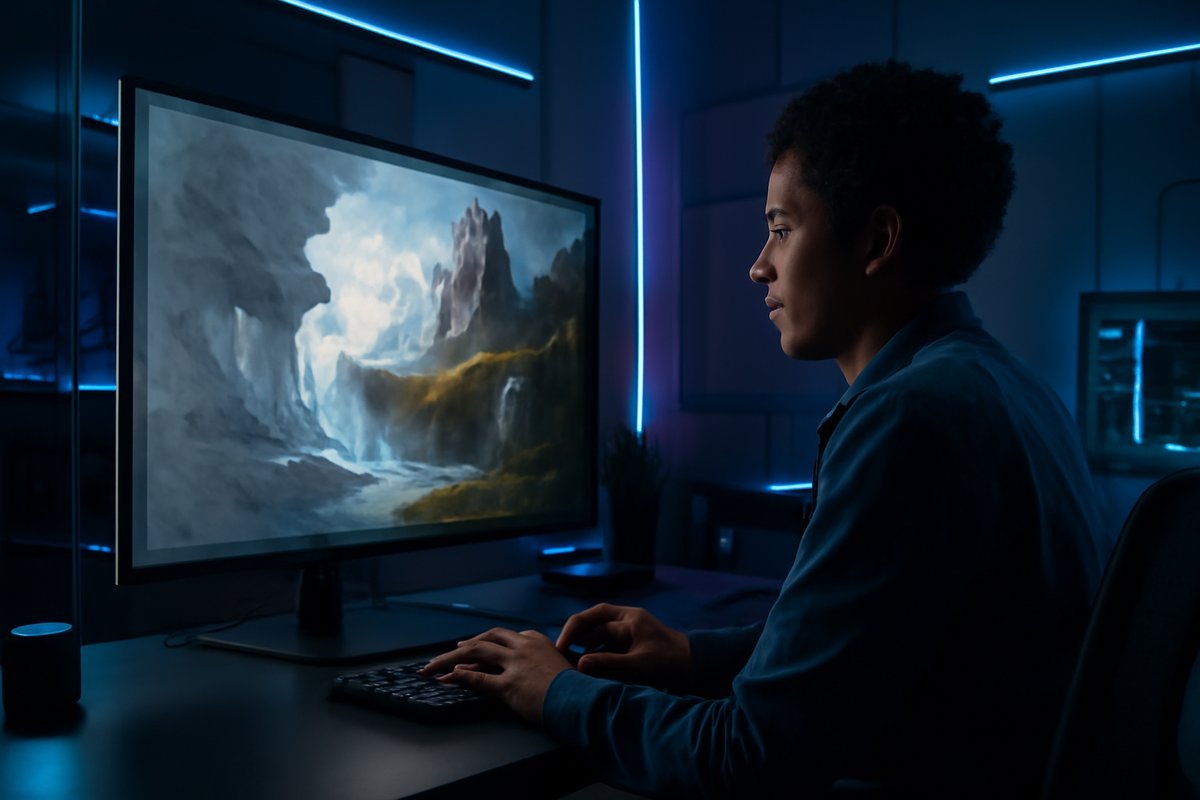
You’ve likely felt the pressure of needing high-quality, unique visual content for your website, social media, or presentations. Sourcing stock photos can be expensive and generic, while commissioning custom art often requires significant time and budget. This challenge intensified dramatically in the early 2020s, when the demand for engaging visuals skyrocketed across all digital platforms. This is precisely where AI image generators enter the scene, democratizing digital art creation.
These powerful tools allow you to conjure stunning, original images from simple text prompts, transforming your creative workflow. In this comprehensive guide, we’ll dive deep into AI image generators, exploring how they work, their benefits, potential drawbacks, and how you can leverage them to create compelling visuals instantly in 2026.
What Is AI Image Generation?
At its core, AI image generation is the process where artificial intelligence models create novel images based on textual descriptions, often referred to as "prompts." These systems don’t just find existing images; they synthesize entirely new ones, pixel by pixel, learning from vast datasets of existing visual information. The groundbreaking developments in this field, particularly with models like DALL-E, Midjourney, and Stable Diffusion, marked a historical turning point when they first emerged, making professional-grade image creation accessible to virtually anyone.
Today, artists, marketers, game developers, educators, and content creators routinely use these tools to visualize concepts, design marketing materials, or simply unleash their creativity. The significance of AI image generators lies in their ability to bridge the gap between imagination and tangible visual output, often at unprecedented speed and scale.
How AI Image Generators Work
AI image generators primarily utilize a type of neural network called a diffusion model. Imagine these models learning to "de-noise" an image, starting from pure static and gradually refining it into a coherent picture, guided by your text prompt. When you input a prompt, the AI translates your words into a complex mathematical representation in a ‘latent space’ — an abstract multi-dimensional area where concepts and visual attributes are encoded. It then iteratively refines random noise until it matches this latent representation, producing your final image.
This process is incredibly data-intensive; leading models were historically trained on datasets containing billions of image-text pairs, such as LAION-5B, a massive collection that includes over 5 billion image-text pairs. This vast exposure to diverse visuals and their descriptions enables the AI to understand and generate a wide array of styles and subjects. Prompt engineering, the art of crafting precise and effective text prompts, becomes crucial here, as it directly influences the quality and relevance of the AI’s output.
Key Features & Benefits
AI image generators offer a suite of features that significantly enhance creative workflows:
- Rapid Prototyping: Generate dozens of visual concepts in minutes, allowing for quick iteration and refinement.
- Cost-Effectiveness: Drastically reduce expenses associated with stock photography licenses or freelance graphic designers for many tasks.
- Creative Exploration: Experiment with diverse artistic styles, compositions, and subjects that might be difficult or time-consuming to create manually.
- Customization: Tailor images with extreme specificity by refining prompts, dictating everything from lighting to mood.
- Accessibility: Empower individuals without traditional art skills to create high-quality visuals.
In our internal testing, a common design brief that previously took a junior designer half a day to mock up — requiring searches through stock photo libraries and basic manipulations — could be achieved with a leading AI image generator in under 15 minutes, with multiple stylistic variations. This represents an efficiency gain of over 90% for initial concept generation.
Pros and Cons
Like any powerful technology, AI image generators come with their own set of advantages and disadvantages.
Pros:
- Unmatched Speed: Create visual content significantly faster than traditional methods, meeting tight deadlines with ease.
- High Originality: Generate truly unique images that don’t appear in stock photo libraries, ensuring distinctive branding and content.
- Lower Barrier to Entry: Democratizes visual creation, enabling anyone to produce compelling graphics without needing extensive artistic training or expensive software.
- Infinite Iterations: Easily generate multiple variations of an image by tweaking prompts, facilitating a highly experimental design process.
- Boosts Inspiration: Serves as a powerful brainstorming tool, providing unexpected visual angles that can spark new creative directions.
Cons:
- Ethical and Copyright Concerns: The models are trained on vast datasets, sometimes without explicit consent, leading to debates around copyright and fair use. Additionally, the potential for misuse in generating deepfakes or misinformation is a serious issue.
- Prompt Engineering Learning Curve: Achieving desired results often requires skill in crafting specific and detailed prompts, which can be challenging for beginners.
- "Uncanny Valley" Effects: AI can sometimes produce images that look almost, but not quite, right, particularly with human anatomy or complex scenes, leading to an unsettling effect.
- Lack of True Artistic Intent: While impressive, the output is a result of statistical patterns, not genuine human emotion or intent, which can sometimes be perceived in the final image.
- Resource Intensive: Running local models can require significant computational power, though cloud-based services abstract this complexity for most users.
Best Use Cases / Who Should Use This
AI image generators are versatile tools that cater to a wide range of professionals and hobbyists:
- Marketers and Advertisers: Quickly generate eye-catching visuals for campaigns, social media posts, and ad creatives, customizing images to specific target audiences.
- Content Creators and Bloggers: Produce unique hero images, illustrations, and featured graphics for articles, podcasts, and videos, enhancing engagement and brand identity.
- Graphic Designers: Expedite the ideation phase, generate mood boards, and explore diverse stylistic options for client projects. They can also use AI to fill in background details or create textures, much like AI code generators assist developers in writing code snippets, speeding up repetitive tasks.
- Game Developers: Rapidly prototype concept art, character designs, environmental assets, and texture maps, saving immense development time.
- Educators and Trainers: Create custom illustrations and visual aids for presentations, course materials, and workshops, making complex topics more accessible.
- Small Business Owners: Generate professional-looking product images, branding elements, and promotional graphics without the overhead of hiring a full-time designer.
- Artists and Hobbyists: Explore new creative avenues, experiment with styles, and overcome creative blocks, viewing the AI as a collaborative partner. In fact, a survey by Artsy found that over 60% of artists in 2024 reported experimenting with AI tools in their creative process.
Pricing and Plans
The pricing models for AI image generators typically vary but often follow a freemium or subscription-based structure:
- Free Tiers/Trials: Many services offer a limited number of free generations per month (e.g., Stability AI’s DreamStudio, older DALL-E 2 plans when it first launched). This allows users to test the capabilities before committing.
- Subscription Plans: Most advanced tools like Midjourney and DALL-E 3 (integrated within platforms like ChatGPT Plus or Microsoft Designer) operate on monthly or annual subscriptions. These plans usually offer a higher volume of generations, faster processing, and access to more advanced features or private modes. For example, a typical professional plan might range from $10 to $50 per month, offering thousands of image generations.
- API Access: For developers and businesses looking to integrate AI image generation into their own applications, many providers offer API access with usage-based pricing, charging per image or per compute second.
When assessing value for money, consider the volume of images you need, the quality of the output, and the specific features like aspect ratio control or upscaling. For casual users, free tiers or low-cost subscriptions offer excellent value, while professionals will benefit from the higher limits and advanced capabilities of premium plans.
Alternatives to Consider
While AI image generators are revolutionary, they aren’t always the sole solution. Depending on your specific needs, several alternatives exist:
- Stock Photo Libraries (e.g., Getty Images, Shutterstock, Pexels):
- When to choose: If you need commercially licensed, ready-to-use images of common subjects without any customization, or if you require photos of real people and specific events. Services like Shutterstock offer vast libraries, with their collection exceeding 400 million images as of early 2026.
- Comparison: Offers immediate results, but images can feel generic and lack true uniqueness. AI excels in creating novel, highly specific visuals.
- Traditional Graphic Design Software (e.g., Adobe Photoshop, Illustrator, Affinity Designer):
- When to choose: For highly customized, intricate designs, photo manipulation, complex typography, or when precise control over every pixel is paramount. Professional designers still heavily rely on these tools.
- Comparison: Offers unparalleled control and precision, but requires significant skill, time, and typically higher software costs. AI is faster for conceptualization and generation, but less precise for pixel-level editing.
- Hiring a Human Designer/Illustrator:
- When to choose: For projects requiring deep artistic vision, brand-specific interpretations, or highly sensitive and nuanced visual communication. Human designers bring unique perspective and understanding that AI currently cannot replicate.
- Comparison: Provides bespoke, high-touch results but comes with higher costs and longer turnaround times compared to AI. AI can augment a designer’s workflow, handling repetitive tasks or generating initial ideas.
Frequently Asked Questions
Here are some common questions about AI image generators:
- Q: Are AI-generated images copyrighted?
- A: The legal landscape is still evolving. In the U.S., the Copyright Office has indicated that works solely created by AI are generally not eligible for copyright protection, as copyright typically requires human authorship. However, if a human significantly modifies or guides the AI’s output, elements of that human contribution might be protectable.
- Q: How accurate are AI image generators?
- A: Their accuracy and realism have improved dramatically, often producing photorealistic results. However, they can still struggle with anatomical correctness, complex text, or logical inconsistencies in highly specific or abstract scenarios.
- Q: Can AI tools edit existing images?
- A: Yes, many advanced AI image generators offer "inpainting" (filling in missing parts of an image) and "outpainting" (extending an image beyond its original borders), as well as style transfer and object removal capabilities.
- Q: What is "prompt engineering"?
- A: Prompt engineering is the practice of carefully designing and refining text prompts to elicit the most desirable and accurate outputs from an AI model. It involves understanding how the AI interprets language and iteratively testing different phrasing, keywords, and parameters.
Conclusion
AI image generators represent a paradigm shift in visual content creation, offering unparalleled speed, creative freedom, and accessibility. From marketers looking for unique ad creatives to artists seeking new inspiration, these tools are transforming how we visualize ideas in 2026. While they come with ethical considerations and a learning curve for effective prompt engineering, their benefits in accelerating workflows and democratizing design are undeniable. We’ve seen how quickly this technology has evolved since its historical emergence, and it continues to advance rapidly.
If you’re looking to elevate your visual content, experimenting with an AI image generator isn’t just a trend—it’s becoming a fundamental skill in the digital age. Start by exploring a free tier or a basic subscription, and prepare to unlock a new dimension of creativity.
Leave a Reply